14x36x1 Nominal vs Actual Size | Why Filters Feel Loose or Tight
Quick Answers
Why Does My 14x36x1 Filter Feel Loose or Tight?
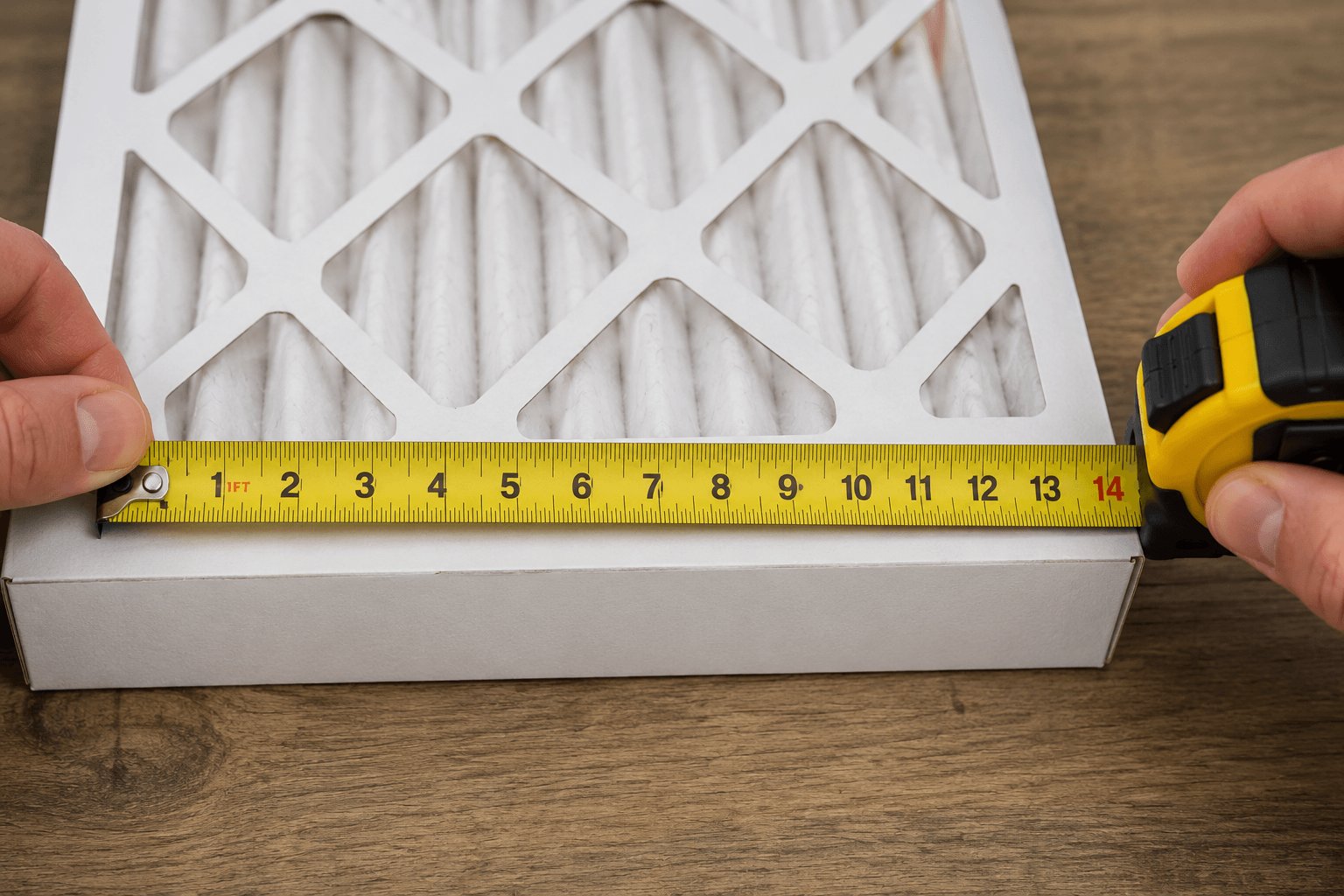
A 14x36x1 filter's actual dimensions run smaller than its nominal label, so a slight gap or snug pull on installation is normal, not a sign you ordered the wrong size. I check this exact question on customer filters more than almost any other sizing complaint I field.
- Actual size for most 14x36x1 filters: roughly 13.5" x 35.5" x 1"
- Why the gap exists: manufacturers undersize filters by design so they slide into the slot without binding
- When to worry: only if the filter won't seat flush against the frame or falls out on its own
- Quick fix: measure your slot directly instead of trusting a faded label
Top Takeaways
- The number printed on your filter's frame, 14x36x1, is a rounded nominal size, not the filter's exact measurement.
- Most 14x36x1 filters measure closer to 13.5" x 35.5" x 1" once you put a tape measure on them.
- That half-inch difference on each side is intentional. It lets the filter slide into the housing without forcing or tearing the frame.
- A filter that feels slightly loose around the edges is normal. One that won't seat flush or drops out on its own is not.
- Measuring your actual slot once saves you from guessing every time you reorder.
What's the Difference Between Nominal and Actual Filter Size?
Nominal size is the marketing number. It's rounded to a clean figure like 14x36x1 because that's easier to search for and stock than a fraction. Actual size is what the filter measures with a tape in hand, and it's almost always a bit smaller on the length and width so the filter can slide into a metal or plastic housing without jamming.
I've pulled filters out of hundreds of systems over the years, and this trips up more homeowners than any other sizing question I get. They open a new filter, notice it doesn't fill the slot edge to edge, and assume they made a mistake. Usually they didn't. The complaint almost always comes in the same words: "it feels loose" or "it's not filling the space." Neither of those is a defect. It's the manufacturing tolerance doing exactly what it's supposed to do.
It's not unique to this size, either. I walked through the same gap on a much thicker filter in my 20x25x5 Air Bear Nominal Versus Actual Size Breakdown, where the difference runs even larger.
Why Your New 14x36x1 Filter Feels Off
If your housing was built for a true 14x36x1 opening, the filter you just installed likely measures closer to 13.5" x 35.5" x 1". That's not a defective product. It's the same undercut you'll find across nearly every standard filter size on the market, usually a quarter to a half inch smaller per side than the number on the label.
The undercut exists for a practical reason. Filter frames are rigid. A filter cut to the exact nominal dimension would need to be forced into the housing. That risks bending the frame or tearing the media. Either way, the filter may not seat flush against the stop. A slightly undersized filter drops in cleanly and still creates a workable seal once it's pushed all the way back.
I've measured 14x36x1 filters from two different brands side by side and found a difference of close to a quarter inch between them, both labeled identically. If you're switching brands rather than reordering the same one, that's worth knowing before you assume something's wrong with the new filter.
The Dimension That Actually Causes Problems Isn't the One People Worry About
Everyone fixates on length and width. Depth is the dimension that actually causes trouble.
A 14x36x1 filter that measures 13.5" x 35.5" instead of a clean 14x36 will almost never cause a real problem. That's the built-in tolerance doing its job. But if the depth comes in off, even by an eighth of an inch, that's a different situation. A 1-inch slot won't accept a filter that runs long on depth without buckling the media or preventing the access panel from closing. I've been called out for "mystery airflow problems" more than once where the real issue was a filter labeled 1-inch that measured closer to 1.125" and was quietly bowing against the door.
Check depth first if you're troubleshooting a fit issue. Length and width give you room to be wrong. Depth doesn't.
How to Confirm Your Filter Actually Fits
A little give around the edges is expected. Here's how to tell if what you're seeing is normal or a real problem:
- Slide the filter all the way back until it stops against the housing frame or a built-in stop.
- Run a finger along each edge. A gap you can barely fit a fingernail into is typical.
- Check that the filter sits flat, not bowed or buckled in the middle.
- If the filter rattles loose, drops when the blower kicks on, or leaves a visible inch of open space on any side, remeasure your slot before assuming the filter is wrong.
If you're installing a replacement for the first time, my Step-by-Step Guide to Installing an Air Conditioner Filter covers airflow direction and seating in more detail.
For reference, Filterbuy's 14x36x1 Air Filter Selection lists the actual size for that nominal category as 13.5" x 35.5" x 1" across MERV 8, 11, and 13.
What to Do if Your Measurement Doesn't Match Any Standard Size
Sometimes you measure the slot, and the numbers don't land cleanly on 14x36x1 or any other stocked size. This happens more than people expect, especially in older homes or houses that have had ductwork modified.
Here's the sequence I actually walk people through:
1. Remeasure the slot opening itself, not the old filter, since a warped filter will give you a false reading.
2. Round each dimension up, not down. A slot that measures 13.75" should be treated as a 14" filter, not 13".
3. Check whether your slot has a filter rack with adjustable rails. Many odd measurements turn out to be a standard slot with a spacer strip installed, and removing it reveals a normal size underneath.
4. If the slot genuinely doesn't match a stocked size after that, a custom-cut filter is the right call instead of forcing a close-but-wrong standard size.
The mistake I see most often at this stage isn't a bad measurement. It's someone forcing a 14x36x1 into a slot that's actually a non-standard depth because it was the closest size on the shelf.
When a Loose Fit Actually Is a Problem
Not every gap is harmless. If the space around the filter is wide enough that you can see daylight through it, or if the filter has visibly shrunk, warped, or been cut down from a larger size, air is bypassing the media entirely. That defeats the point of the filter regardless of its MERV rating. A filter that's genuinely too small for its housing usually shows other signs too, like whistling airflow noise or the filter shifting position between changes. I've had homeowners describe that whistle as the first clue something was wrong, well before they noticed the fit issue itself.
Edward Broward, who wrote this piece, put it this way:
Expert's Quote
"The tape measure beats the printed label every time. I've had more than one homeowner call convinced their new filter was defective, and the fix was always the same five-minute check against the actual slot, not the number on the box."
Essential Resources on "14x36x1 Air Filter"
Confirm Your Filter Actually Fits and Performs
The EPA's consumer guide walks through selecting a MERV rating your HVAC system can handle and checking that a filter seats snugly without gaps. It's the fastest way to avoid buying a filter that looks right on paper but leaks air around the edges.
https://www.epa.gov/indoor-air-quality-iaq/guide-air-cleaners-home
Know Exactly When to Replace It
ENERGY STAR recommends checking filters monthly and replacing them at least every 3 months. Following this cadence keeps a 14x36x1 filter working as intended instead of quietly dragging down airflow and energy costs.
https://www.energystar.gov/saveathome/heating-cooling
Get the Installation Right the First Time
The Department of Energy's Building Science Education Center explains where filters belong in the system and why a dirty or improperly seated one undercuts performance regardless of MERV rating.
https://bsesc.energy.gov/energy-basics/hvac-proper-installation-filters
Stop Air from Bypassing the Filter Entirely
ASHRAE's filtration FAQ explains what happens when air moves around a filter instead of through it, and offers simple fixes if a 14x36x1 slot runs loose. A filter that doesn't seal properly performs like a much lower MERV rating.
Choose the Right Filter for Allergy Relief
The Asthma and Allergy Foundation of America identifies filtration as one of the core controllable factors in indoor air quality. Useful context for anyone buying a 14x36x1 filter specifically to manage allergy symptoms at home.
https://aafa.org/asthma/asthma-triggers-causes/air-pollution-smog-asthma/indoor-air-quality/
Understand the Health Payoff of Better Filtration
The American Lung Association connects indoor air quality and filtration directly to asthma symptom control. Helpful if health outcomes, not just cost, are driving the decision on which filter tier to buy.
https://www.lung.org/blog/asthma-and-air-pollution
See Filtration in the Bigger Picture
HUD USER places filtration alongside ventilation as part of a whole-house indoor air quality strategy. Useful for deciding whether a filter upgrade alone will move the needle or whether other steps matter too.
https://www.huduser.gov/archives/portal/consumer/indoor_air.html
Supporting Statistics
1. Nearly 9 in 10 U.S. Homes Rely on This Kind of Filtration
- 88% of U.S. households used air conditioning in 2020.
- Two-thirds relied on central AC or a central heat pump as main equipment.
- That's the installed base where a correctly sized 14x36x1 filter matters.
Source: U.S. Energy Information Administration
https://www.eia.gov/todayinenergy/detail.php?id=52558
2. Respiratory Health Makes Filter Choice a Real Decision
- 8.6% of U.S. adults currently have asthma (2024).
- 6.5% of U.S. children currently have asthma (2024).
- For millions of households, MERV rating is a health decision, not just an HVAC one.
Source: CDC/National Center for Health Statistics, FastStats: Asthma
https://cdc.gov/nchs/fastats/asthma.htm
3. There's an Expert-Backed Minimum Worth Knowing
- MERV 6-8 is the expert-recommended minimum for filtering outdoor particulates.
- Higher MERV is recommended for allergy-prone households.
- Higher MERV is also recommended for homes with heavy mold spore or dust exposure.
Source: National Center for Healthy Housing, "Ventilation and Indoor Air Quality"
What I Wish Every Retailer Told Buyers at Checkout
If I could add one line to every filter box at checkout, it would be this: the number on this label is not what you'll measure when it arrives.
That single sentence would eliminate most of the "is this filter defective" calls I get. Instead, buyers find out about the nominal-versus-actual gap only after they're already holding a filter that looks smaller than expected, second-guessing a purchase they made correctly. The fix isn't complicated. It's a labeling and communication gap, not a manufacturing one.
Final Thoughts & Opinion
The nominal-versus-actual gap isn't going away. It's baked into how filters are manufactured, and it serves a purpose: a filter cut to the exact nominal number would be harder to install and more likely to be damaged on the way in.
I think the bigger problem isn't the sizing convention itself. It's that almost nobody explains it to homeowners at the point of sale. I've measured filters for people who'd been quietly ordering the wrong brand's version of the same nominal size for years, never realizing the actual dimensions didn't match their housing. Nobody told them to check.
What I'd tell anyone second-guessing a new 14x36x1 filter is this: measure before you worry, and save the real troubleshooting for a filter that won't seat flush or keeps falling loose.
FAQ
Is a 14x36x1 Filter Supposed to Have a Gap Around the Edges?
A small gap, usually a quarter to a half inch per side, is standard and by design. It lets the filter slide into the housing cleanly.
What Is the Actual Size of a 14x36x1 Filter?
Most run close to 13.5" x 35.5" x 1", though exact dimensions vary slightly by manufacturer.
How Do I Know if My Filter Is Actually the Wrong Size?
Check whether it seats flush against the housing frame. If it won't sit flat, rattles, or drops loose during operation, remeasure your slot rather than assuming the label is correct.
Should I Order a Size Up if My Filter Feels Loose?
No. Ordering a larger nominal size to compensate usually creates a worse fit, since the actual dimensions will be too large for the slot. For the full breakdown by filter material and thickness, see my guide on How Often You Should Replace Your AC Filter.
Glossary
Nominal size: The rounded dimension printed on a filter's frame, such as 14x36x1. It's a labeling convention, not a precise measurement.
Actual size: The filter's true, tape-measured dimensions, typically a quarter to a half inch smaller per side than the nominal size.
MERV rating: Minimum Efficiency Reporting Value, a 1-16 scale measuring how effectively a filter captures airborne particles. Higher numbers capture smaller particles but can restrict airflow more.
Fit is half the equation. The other half is picking the right filter in the first place, so here's what I point people toward once the sizing question is settled.
Learn more about HVAC Care from one of our HVAC solutions branches…
Filterbuy HVAC Solutions - West Palm Beach FL
1655 Palm Beach Lakes Blvd., Ste 1005 West Palm Beach, FL 33401
(561) 448-3760
https://maps.app.goo.gl/VarpgNZnxuPQuW8A7