MERV 13 24x25x5 Filter Airflow on Day and Night Furnaces
TL;DR
In most homes, no. A MERV 13 filter in the 24x25x5 size spreads air across far more pleated media than a 1-inch filter, so it starts with modest resistance on a Day and Night furnace. Trouble usually traces to an overdue or poorly fitted filter, and sometimes to tight ductwork, so judge depth and fit before the MERV number.
Key Takeaways
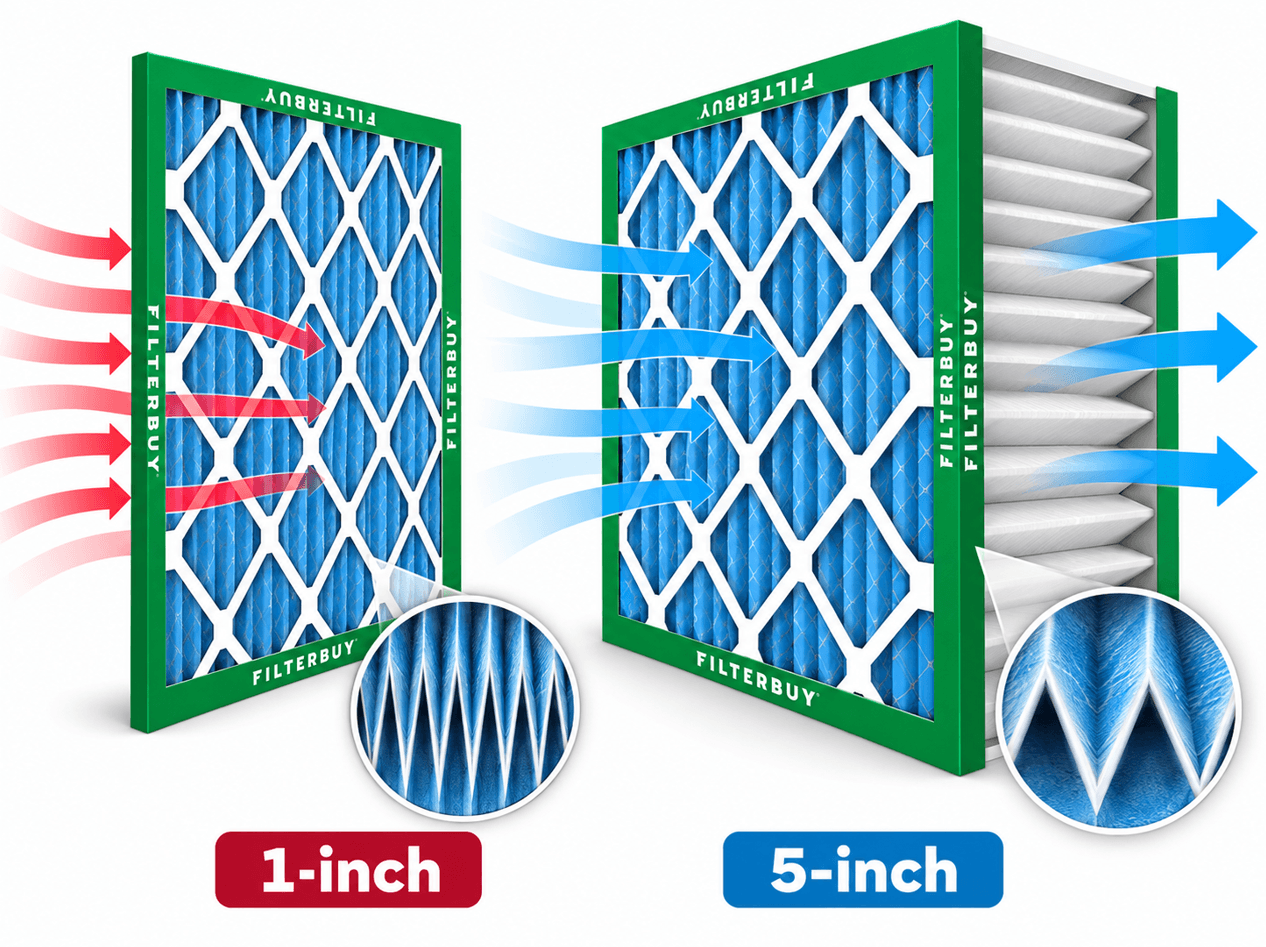
Depth beats MERV. A 5-inch pleated filter carries several times the media of a same-face 1-inch filter, so air moves through slowly and meets less resistance.
Restriction is a timing problem. A clean MERV 13 media filter starts with low resistance; months of loading are what raise it.
The filter shares a pressure budget. It splits 0.5 to 0.8 inches of water column with the coil and ductwork.
Blower type changes the symptom. Variable-speed blowers spend more electricity to hold airflow; single-speed blowers move less air.
How Does a 5-Inch Media Filter Handle MERV 13 Without Choking Airflow?
A 5-inch media filter handles MERV 13 by spreading air across deep pleats, which slows it through the media and keeps resistance low. Every air filter trades airflow for capture, so I ran the numbers for this size. A 24x25 face covers roughly 4.2 square feet, and a blower moving 1,200 cubic feet per minute pushes air across it at about 290 feet per minute. Deep pleats spread that air over several times more media than a 1-inch filter can.
The EPA explains that a MERV rating describes how well a filter captures particles between 0.3 and 10 microns. Higher ratings catch more fine particles, and denser media resists more air, so depth is what keeps MERV 13 practical.
The comparison that matters is not MERV 8 versus MERV 13; it is 1-inch versus 5-inch. Filterbuy sells pleated filters in every common depth, so the difference is easy to see. A 1-inch pleated furnace filter has shallow pleats, a 2-inch MERV 8 filter adds a little depth, and a 4-inch MERV 11 filter approaches cabinet-style media. Thin sizes such as a MERV 8 16x22x1, a MERV 8 20x24x1, or a MERV 8 16.5x22 filter follow the same rule. A 1-inch MERV 13 filter carries the same rating across far less surface, which is where most restriction complaints begin.
Which Day and Night Furnaces Use 24x25x5 Air Filters?
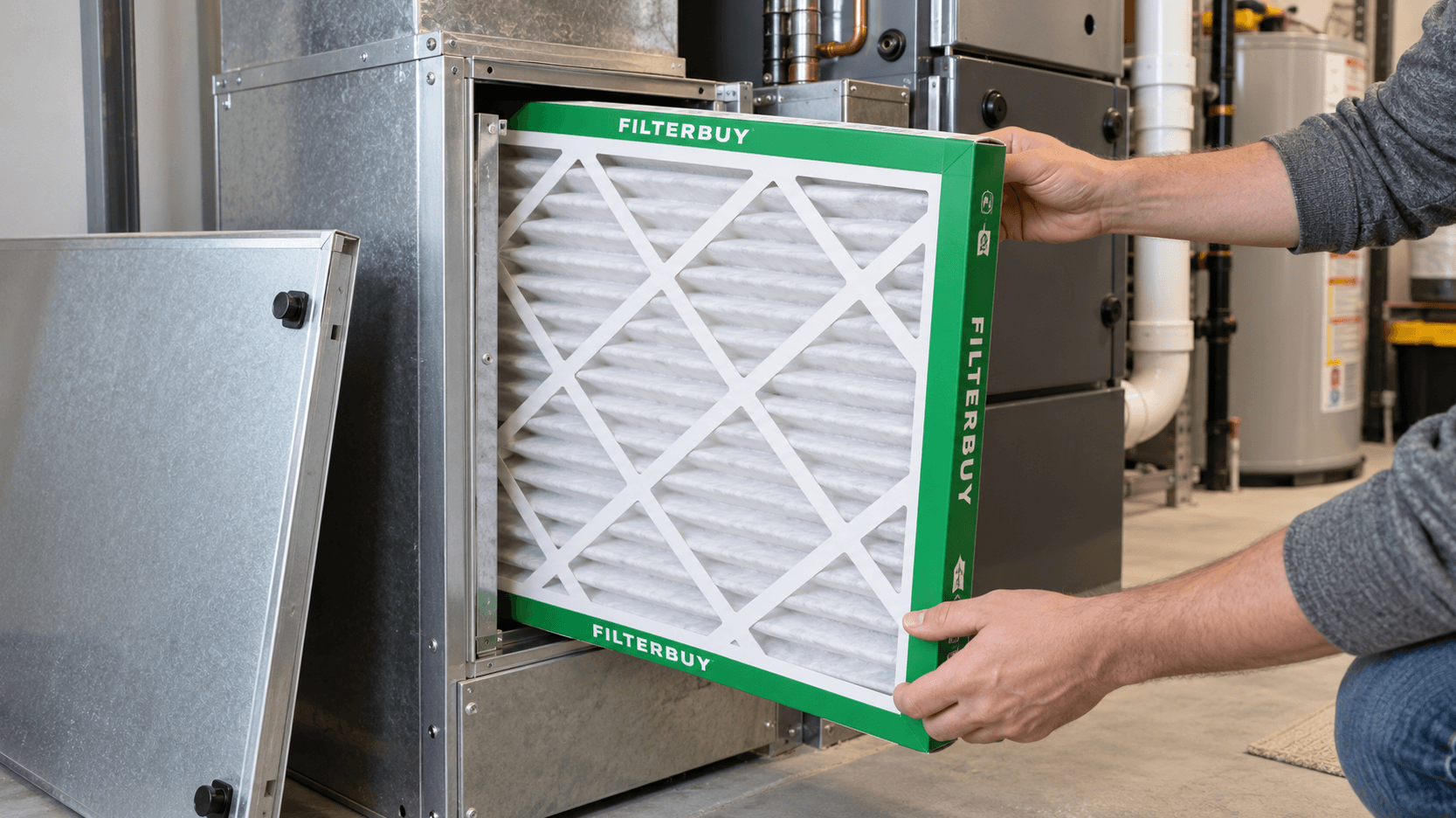
Day and Night gas furnaces commonly pair with a 24 x 25 accessory media cabinet, and that cabinet takes a 24x25x5 air filter. Day and Night is a residential heating and cooling brand within the Carrier family of companies. The 24 x 25 cabinet listings I reviewed for this piece are rated for about 2,200 cubic feet per minute, enough for most systems, though five-ton units run close.
The Filterbuy 24x25x5 Day and Night air filter is a 5-inch nominal pleated media filter sized for the 24 x 25 media cabinet used with Day and Night furnaces, measuring about 23.63 x 24.69 x 4.25 inches, offered in MERV 8, MERV 11, and MERV 13, and made in the USA in Talladega, Alabama. By my math, that trim costs under 3% of face area, a fair price for a filter that slides in without crushing its pleats.
What Actually Causes Airflow Restriction on a Day and Night Furnace?
Restriction on a Day and Night furnace usually comes from four sources, listed in the order I would check them, cheapest first:
An overdue filter. Loaded media is the most common cause of a sudden airflow drop.
The wrong depth. A thinner filter loose in a 5-inch slot lets air slip around the edges; dark dust streaks on the frame are the giveaway.
Undersized or leaky return ducts. A tight return leaves no pressure to spare, and leaky runs may need duct repair.
A poorly sealed cabinet door. Gaps pull in unfiltered air, and in laundry-room installs, lint from a neglected dryer vent loads filters faster.
Building America field research on furnace blowers, summarized by the U.S. Department of Energy, found common blowers run at only 10% to 15% efficiency, leaving little margin for a restrictive return.
Does the Blower Type in a Day and Night Furnace Change the Answer?
Yes. Many newer Day and Night furnaces, built under federal furnace fan efficiency standards, use ECM blower motors that ramp up to hold airflow. Older single-speed PSC motors lose airflow instead, and if one cannot handle MERV 13 at all, it may be time to price HVAC replacement from local HVAC replacement companies.
With a variable-speed blower, you rarely feel restriction at the registers; the cost shows up as fan energy and noise. With a PSC blower, weak airflow is the warning, and in cooling season the indoor coil can frost. In Florida, where blowers run most of the year, I would check filters more often in summer.
What Are the Signs a MERV 13 Filter Is Restricting Airflow?
A restricted MERV 13 filter usually shows itself in five ways:
Noise: whistling, sucking, or rattling sounds at the cabinet door
Filter shape: pleats bowed toward the blower side
Comfort: weaker airflow from supply vents
Heating cycles: short cycles or a tripped limit switch
Cooling season: ice on the refrigerant lines or indoor coil
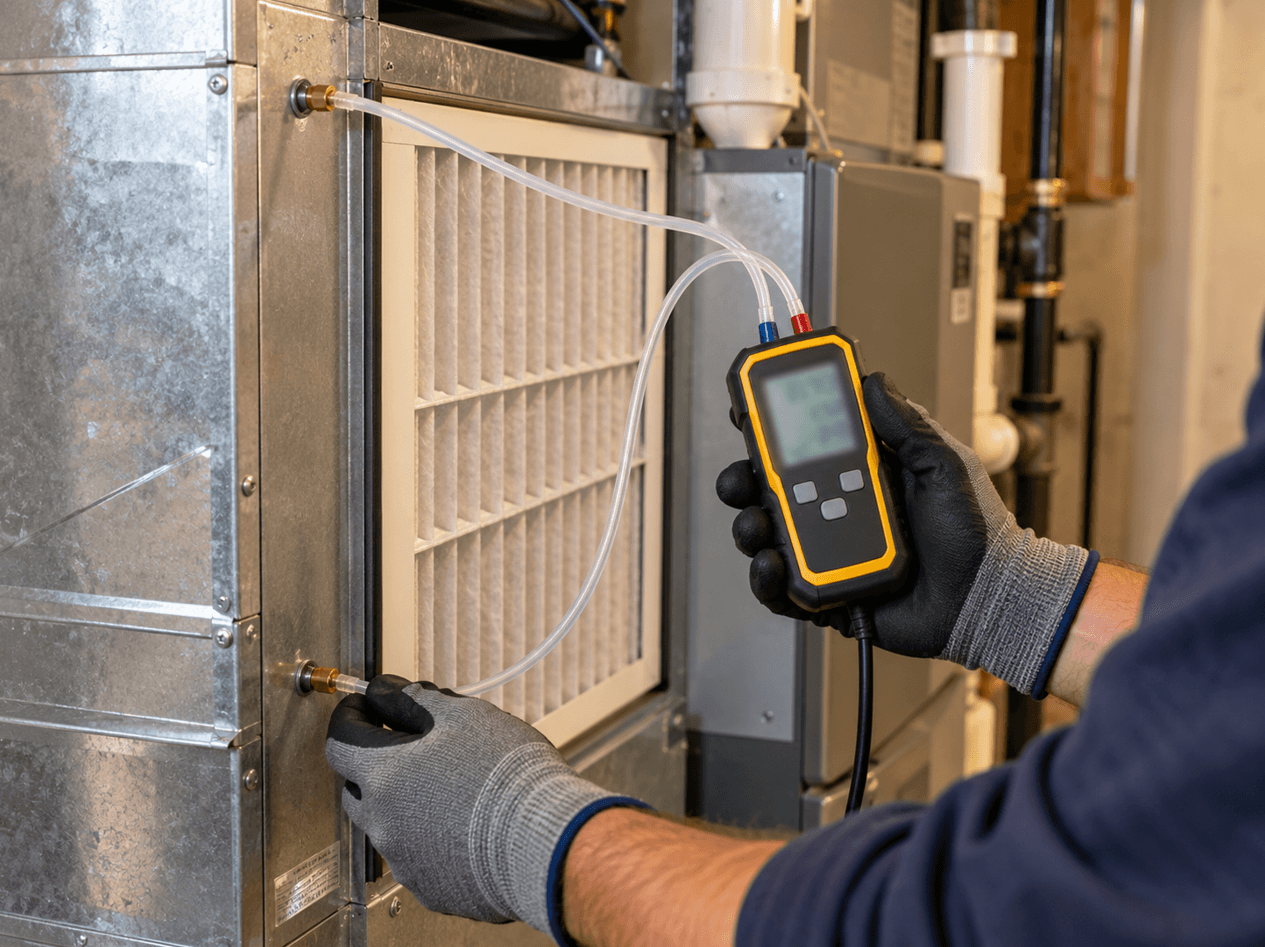
If you notice two or more, install a fresh filter and write the install date on its frame. If symptoms return quickly, a technician can measure total external static pressure with a manometer and check it against the furnace rating plate.
How Can You Check Fit and Filter Load Yourself?
You can check fit and filter load in about two minutes. Skip the light test: it works for thin fiberglass filters, but dense MERV 13 media blocks most light even when new. Instead:
Look for gaps. Any gap wider than a pencil around the seated frame is a bypass path.
Check the arrow. It should point toward the furnace.
Read the intake face. Gray buildup across the whole upstream side, edges included, means the media is loading.
Ask for a filter-only reading. A technician can measure pressure drop across the filter alone, showing whether it, not the ducts, is the problem.
Which 24x25x5 MERV Rating Is Right for You: 8, 11, or 13?
MERV 13 suits most homes with a properly fitted cabinet and healthy ducts, especially homes with allergies or pets and areas prone to wildfire smoke, and it traps many germ-carrying particles too. MERV 11 suits older systems with tighter ducts. Filterbuy's MERV 8 24x25x5 filter covers basic equipment protection, and Canadian homeowners can order the same MERV 8 size from a Canadian supplier.
ASHRAE and public health agencies both back MERV 13, and this overview of the different types of MERV filters explains each level. My rule of thumb: if a home has a history of airflow complaints, start at MERV 11 and step up after a static pressure check.
“After writing sizing guides for this site, the pattern I see most is readers blaming the MERV number when the real culprit is a filter that never fit the cabinet. Measure the slot, match the depth, and MERV 13 usually takes care of itself.”
Edward Broward, author
Essential Resources
Day and Night 24x25x5 replacement air filters in MERV 8, 11, and 13: This product page lists actual dimensions and MERV options for the 24x25x5 size.
ENERGY STAR: Heating and Cooling Maintenance Checklist: ENERGY STAR recommends inspecting HVAC filters once a month and scheduling seasonal check-ups.
Building America Solution Center: Understanding MERV, NAFA User's Guide for ANSI/ASHRAE Standard 52.2: This NAFA guide explains how ASHRAE Standard 52.2 testing defines each MERV level.
National Air Filtration Association: Residential Air Filtration Guideline: NAFA's residential guideline sets best practices for selecting and maintaining home filters.
ASHRAE: Guidance for Residential Buildings: ASHRAE recommends MERV 13 or the highest rating a home system can accommodate.
Lawrence Berkeley National Laboratory: Residential Furnace Blower Performance: LBNL blower testing recommends deep 4-inch pleated filters as a low-pressure option.
Public Health Seattle and King County: HVAC Systems and Indoor Air Quality: The county health department reports that MERV 8 filters capture 30% to 40% fewer particles than MERV 13.
Supporting Statistics
106 million: More than 106 million people in the U.S. experience allergies each year, according to the Asthma and Allergy Foundation of America, Allergy Facts and Figures.
Two-thirds: Two-thirds of U.S. households cool with central air conditioning or a heat pump, according to the U.S. Energy Information Administration, Today in Energy.
At least 50%: MERV 13 filters must remove at least 50% of the smallest particles tested, according to the U.S. EPA, Guide to Air Cleaners in the Home.
Final Thoughts
For most Day and Night furnace owners, MERV 13 in the 24x25x5 size is a fair trade: cleaner air for modest added resistance, as long as the filter fits and stays fresh. Clean filtration also protects the cooling side, as this look at how furnace filters affect air conditioner longevity explains.
Next Steps
Pull the current filter and read the size on its frame.
Choose MERV 11 or MERV 13 to match ductwork age and household needs.
Set a monthly reminder to inspect the filter.
Book a static pressure check if symptoms return after a filter change.
Frequently Asked Questions
Can I Use a 4-Inch Filter in a 24x25x5 Slot?
Only if the cabinet maker approves it. A 4-inch nominal filter sits roughly half an inch shallower than this filter's 4.25-inch actual depth, and that play lets air bypass the filter, defeating MERV 13.
How Often Should I Change a 24x25x5 MERV 13 Filter?
Filterbuy recommends replacing this size every 90 days or so, every six weeks with asthma or allergies, and every two months with pets. Inspect it monthly, as ENERGY STAR advises; by comparison, 1-inch filters need changing far more often in winter. Deep filters like a MERV 8 16x20x4 follow their own schedule, and this guide covers how often to replace an air conditioner filter in general.
Will a MERV 13 Filter Raise My Energy Bill?
A clean one adds very little, but a clogged filter raises winter energy costs. Replacing it on schedule keeps that cost in check.
Does a Larger System Need a Different Filter?
Not a different size, but closer attention. A five-ton system moves roughly 2,000 cubic feet per minute, near the cabinet's rating, so I would inspect its filter more often than on a smaller system.
Keep Your Day and Night Furnace Breathing Easy
A MERV 13 24x25x5 filter and a Day and Night furnace work well together when the fit is right, and the filter stays fresh. Measure the cabinet, pick your rating, and schedule a monthly filter check.
Glossary
MERV (Minimum Efficiency Reporting Value): A 1 to 16 ASHRAE 52.2 rating of particle capture from 0.3 to 10 microns.
Media cabinet: A housing between the return duct and furnace that holds a 4 to 5-inch-deep filter.
Static pressure: Resistance to airflow across the filter, coil, and ducts, in inches of water column.
Filterbuy 24x25x5 Day and Night air filter: A 5-inch nominal pleated media filter sized for the 24 x 25 media cabinet used with Day and Night furnaces, measuring about 23.63 x 24.69 x 4.25 inches, offered in MERV 8, MERV 11, and MERV 13, and made in the USA in Talladega, Alabama.
Learn more about HVAC Care from one of our HVAC solutions branches…
Filterbuy HVAC Solutions - West Palm Beach FL
1655 Palm Beach Lakes Blvd., Ste 1005 West Palm Beach, FL 33401
(561) 448-3760
https://maps.app.goo.gl/VarpgNZnxuPQuW8A7


